Welcome!

I'm a wife to my "Mr. Right". A momma of five. A maker of slow food and simple living. A keeper of memories, a collector of books, and a champion for books that make memories. An addict who likes my half-and-half with a splash of coffee. A fractured pot transformed by the One Who makes broken things beautiful. I heart homeschooling, brake for libraries, and am glad you're here with me on the journey! Be sure to subscribe to my monthly newsletter. Or, follow along with Facebook, Instagram, or Pinterest.

ABC Book: Letter X

Admittedly, the letter "X" is probably the most difficult letter of the alphabet to illustrate.  Let's face it, the number of "X" words is quite limited.


So when faced with the challenge of creating some kind of "X" themed craft for Blonde Warrior to add to his ABC book, I chose a common phrase rather than a word.


I cut two strips/sections from a old map.  (Normally, I would have had Blonde Warrior do the cutting himself, but the sheer size of the fold-out map was a bit too much for his little hands to maneuver.)    I, then, encouraged him to glue them across the "X" pattern on his page.  He used a red marker to make a small "x" on one strip of map.  

So for this week, "X, marks the spot!"

Science Experiment: Heat Rises


We have embarked on a short science unit about ENERGY.  "Heat" energy was the focus one day last week. 

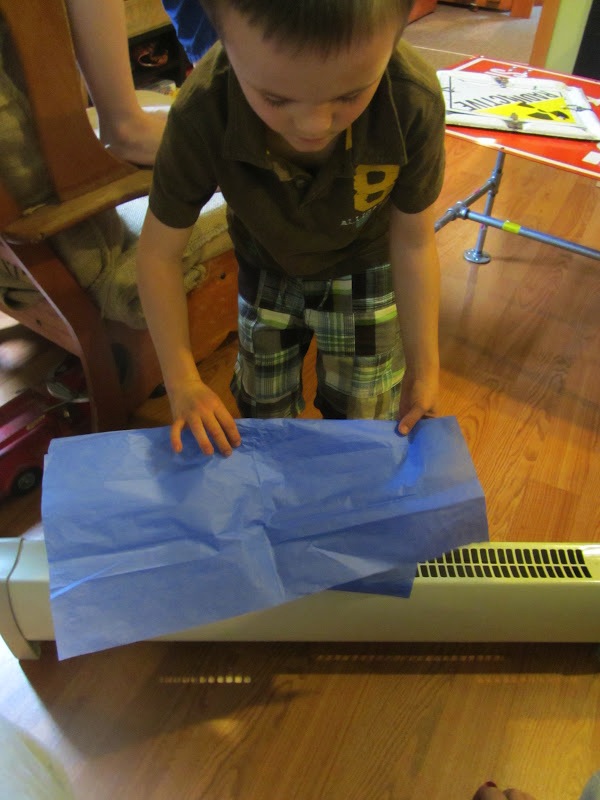
To illustrate the energy that HEAT has and gives off, we headed downstairs to the "man cave" where the Hubs keeps a small space heater.  The kids gathered 'round with tissue paper in hands.  I flipped on the heater and we waited a few moments for the heat to begin dispersing.  

The Littles each took turns placing their tissue paper over (but, NOT on...for obvious fire safety reasons) the heat.  As I had predicted, each of the sheets of tissue began to slowly rise or move as hot air pushed up on them.  It was a physical showing of heat "rising" and displacing cold air.

Tuesday's Tot Trio #7

Are you in need of a few tot-friendly "to dos" for your little one during the school day? Here are three easy tot-school ideas to encourage productive exploration and learning for your littlest of learners.

(This post contains affiliate links. Please see my disclosure policy for full details.)

tot school idea-water painting

Although my little Greased Lightning looooooves to paint, it isn't always convenient to drag out the paints and later clean up the mess. A quick alternative is water painting. By using a piece of colored construction paper and a bowl of water, he can enjoy the fun of painting and I can avoid the mess.

tot school idea-matching socks


Sock sorting is another fan favorite. I stockpile all the unmatched socks for a few weeks and then let Greased Lightning and older brother, Blonde Warrior, race to find as many matches as they can. Admittedly, not much "matching" actually takes place. Some of the more colorful or patterned socks find their mates, but large quantity of all-white eventually just become an indoor snow ball fight...which is fine by me, because it keeps little hands busy and encourages a brotherly bond.


I taught preschool on and off for a few years and found that Fisher Price's Oreo Matchin' Middles game to be a perfect cognitive lesson for little ones. It can be played as a simple match up exercise by finding the white and dark "halves" that fit together. Or, for more advanced skill-building, it can also be used as a simplified version of the classic Memory game. I picked this one up at a garage sale when Sweetie Pea was little, but still find it on the shelves of most toy stores.


Math Mastery vs. Spiral Review

When I was taking my first baby steps on this homeschooling path, I felt pretty confident in my curriculum choices based on much research and prayer. But, no matter how much information I gathered, how many homeschool veterans I spoke with, how many online reviews I read, I felt very hesitant when faced with the decision to purchase one math curriculum versus another. It was not for lack of choices that I was so uncertain. On the contrary, a wide array of quality programs was precisely what made my verdict so difficult.

After deliberating for nearly an entire spring, I finally came to one conclusion...even when presented with a multitude of choices, there were and are really only two options...two possibilities...two perspectives of how math should be taught and, consequently learned. A thorough appraisal of any/all of the math curriculums on the market today would place them each in one camp or the other...curriculums that focus on math mastery versus those that contain a more spiral review.

Once I recognized that simple distinction, the choice for my family was clear.

Let me preface the following remarks by saying that I am in no way declaring this to be an educational dogma. These are simply my thoughts on the two positions and how one naturally works better for my kids than the other.

I have chosen a math curriculum that emphasizes spiral review for the following four reasons...

Math Mastery Vs. Cyclical Review-The Unlikely Homeschool

My children can enjoy a DAILY feeling of success even while learning a difficult math concept.

A curriculum that focuses on a spiral path introduces a new concept, but also has daily review in previously learned concepts. For instance, the new concept of long-division might be introduced and comprise the majority of a lesson. But the lesson will also have a few moments of review in measurements, calendar time, and counting money. My learner might really struggle with long division, but can end the lesson on a "good note" and have a feeling of success when he/she gets to work on a few practice problems of calendar time...something that comes more easily/natural to him/her.

On the flip side, if we were using a math mastery curriculum, long-division would be the entire lesson...and could possibly be the entire lesson for weeks or even months. Imagine how deflating it would feel knowing you had weeks of "struggles" to look forward to.

My children can glean from continual review.
Because the whole concept behind the spiral approach is to introduce a new concept and continue to review and add onto that same concept every few weeks, my kids get constant review of every topic. The review is usually done with a very cumulative rotation so that even by the end of the year, they have not forgotten any of the concepts learned on Day 1.

It might sound logical to think that once a child has "mastered" addition that he/she will remember the entirety of the addition facts for years to come. But, any mother can attest to the "black hole" that happens during summer break. Somehow, thoughts that seemed permanently etched on a child's brain in the spring, suddenly prove to be MIA by fall. So without constant review, can mastery ever really happen?

Mastery might never happen.

I was taught all my multiplication facts in grade school and later went on to high school where those basic skills were stretched and used in more difficult implementations. College math extended my use of the "basics," Skip ahead a few years when I was standing in front of a classroom of third graders teaching the multiplication facts to a handful of eager learners.

Even after all of those lengthy encounters with the infamous "table," I still to this day, do not have my seven times family completely mastered.

If I were required to be thoroughly proficient with the sevens before I was allowed to continue on in my math journey, I would be a Thirty-something still struggling through lesson 5 of the third-grade math text.

And that brings me to my children...although it is my goal to help them become proficient in all areas of traditional math, I recognize that mastery, or at least mastery of ALL, might never happen. But, perhaps, mastery can occur in MOST areas if a child is given the opportunity to learn many different math notions at the same time, as in the case of spiral review.

Spiral Review provides a natural link from one concept to another.

Because the very nature of the spiral approach is to take a "known" concept and add a little of the "unknown" to it every few weeks, this form of math shows an innate relationship of one math concept to another. For instance, my daughter began learning to count by five early on in her kindergarten year. A few short weeks later, she used that skill when learning to count nickels and eventually minutes on the clock.

The mastery approach, on the other hand, would have taught skip counting (counting by fives) in one unit. Weeks, months, or even perhaps a year later, money would be introduced...but the two concepts would not necessarily be linked in any obvious way. In the end, what is the point of counting by fives? Is it just to master counting? Or is counting by fives just the baby step leading a child to other more difficult math concepts? And if so, shouldn't the link be obvious to the learner?

Again, like all other homeschooling choices, a math curriculum decision is up for great debate. But, as there are really only two possible alternatives, this makes the choice a tad bit easier. Math mastery or spiral review--which camp do you prefer?

Toothpaste Millionaire, Part 2

As was promised, our book club gathered this past week to tackle the last half of Jean Merrill's (affiliate link) The Toothpaste Millionaire.  The Architect's wife did an amazing job of showing how useful basic math skills are in everyday life.  


As I mentioned in Part 1 of our unit study, the story details how a young Rufus Mayflower concocts a budget-friendly recipe for toothpaste, puts forth a little entrepreneurial/sales effort, and ends up becoming a millionaire.  To illustrate the concept of saving money by opting for "homemade" instead of store bought, the Architect's wife decided to lead the kids in calculating how much each family would save by making their own dishwashing soap instead of purchasing it at the store.

The children were immediately able to see the valuable use of consumer math.

ABC Book: Letter P

Blonde Warrior is working his way through the alphabet.  In an effort to learn a new letter each week, he has been completing the pages of a homemade alphabet book .  Each page is a different letter and is decorated by using some art medium or theme that begins with that particular letter.


This past week, was "P" week.  He used a cosmetic swab to create Purple Polk-a-dots on his page.


Tuesday's Tot Trio #6

Welcome to my weekly Tot Trio. I hope the following three tot-friendly ideas will inspire some creative activities at your school table this week.


Greased Lightning joined us for our Language lesson. His "assignment" was to transfer these colored pom-poms from their container to the ice tray using a pair of kid-sized tongs. (He used the tongs that came with our pretend doctor kit, but a small pair of ice tongs or even fingers would work just as well.) He has slowly began to master and even insist upon sorting by color. So, he chose to group the pom-poms in separate squares according to hue.


Next came a NO MESS painting activity. I placed three blobs of finger paint onto a piece of paper, put the paper in a gallon sized storage bag, sealed it to the table with packaging tape, and let him and Blonde Warrior squish themselves a masterpiece.


As an added bonus, this little art lesson proved to encourage a discussion on color mixing.


And for his last tot "to do", Greased Lightning spent some time threading our lacing cards. These are just an inexpensive set I purchased a few years ago at Walmart, but you can always make your own using some basic supplies. Here are a few tutorials to get you started...

Little Birdie Secrets
A Girl and a Glue Gun


Silent Math

 Sometimes when my Littles are a bit antsy or becoming easily distracted during school, I find that my SILENCE is more attention getting than my ability to wax eloquently about a particular topic.  

SILENCE even has proven quite "handy" during a math review.  This past week, instead of our traditional flash card review of his addition facts, Super Boy sat down with me to do a few minutes of SILENT MATH.  


I used my fingers to "announce" an addition fact, and he had to use his fingers to "announce" his answer.


By using my hands...NOT my MOUTH or a fancy FLASHCARD...I commanded more of his senses/attention.  He had to give me his complete attention or risk missing a part of the math fact.


In addition (no pun intended), he had to use increased reasoning skills to be able to supply the answer in a non-traditional form.  


As I hoped, SILENT math helped reign in and focus his thoughts on a busy afternoon.


Hip Homeschool Hop Button

St. Patrick's Day 2012

As the Hubs is somewhere between 1/4 and 1/8 Irish on his mom's side, every year on March 17th, I try to throw together a few St. Patrick's Day activities. Due to our faith and convictions about many things, we choose not to focus very much on the leprechauns and magical elements of the day, but instead just focus on the fun green traditions and the history behind the holiday.

(This post contains affiliate links. Please see my disclosure policy for full details.)


To start things off, I served up bowls of Lucky Charms for breakfast complete with "Irish Milk" (milk dyed with a few drops of green food coloring.)

Salt Painting


We are currently working our way through Usborne's Complete Book of Art Ideas.  Last week, our weekly art lesson introduced us to water color salt painting.  We have done salt works before but never with such intentional themes.  This lesson just happened to fall on THE perfect day.  Although the suggested subject matter was an under water scene, I opted for something a little more closer to home.  

We had just gotten a fresh dumping of snow the evening before and when we were considering what we wanted to paint, all we had to do was look outside and see this magnificently powdered crab apple tree and knew that it would make for a perfect salt "muse."


Our first step was to lightly draw a rough sketch while looking out the window at the tree.


Then, we painted a water wash over the entire sheet of paper.  (We did not use traditional water color paper...but just a heavy weight, all-purpose art paper.)


Next, we used a light wash of blue for the sky.


We sprinkled a handful of course salt over the entire "sky."  Our goal was to break up some of the color to make a "falling snow" look.


We decided to paint a pale brush of grey across the sky/snow line to make it more of an obvious division.


Next came the tree.  We followed the basic sketch lines that we had previously drawn to make our crab apple trees.


Another modest sprinkling of salt over the tree and our work was complete.  All that was left to do was wait as the salt did its work.


You can see from the finished products that the salt worked really well to create a winter scape of falling snow.

Don't live in "snow country?"  No worries.  Water color salt paintings are great for ANY nature scene. If your spring has "sprung," try your hand at painting some flowers or a budding tree.  The salt gives every painting a natural textured look.

Homeschool Convention Tips

With the arrival of spring, comes the promise of fresh starts.  If you are anything like me, your thoughts are already filled with notions of next year.  What curriculum will be continued?  What curriculum will need to be replaced or changed altogether?  Should I add or detract from our school day schedule?Where can I find the best deal on my lengthy list of needs...or wants?

Or perhaps, you are stuck in a spring-time slump and have "grow(n) weary in well-doing."  Maybe you need a few encouraging thoughts to help bolster your home schooling efforts.

Whichever camp you currently find yourself in, be strengthened by the thought that Homeschool Convention "season" is just around the corner.  And with it comes the perfect opportunity to gather with other folks of like-mind and share in the cheers and jeers of the journey you were called to when you embarked upon Homeschooling.

Whether you are new to homeschooling or are a seasoned veteran, attending an annual Homeschooling Convention always brings substantial benefits.  But, before you register and pack your bags, here are a few helpful hints to keep in mind...

If possible, come with a skeletal plan of what curriculum you might be interested in purchasing.  

(If this is your first year homeschooling or you are just in "prayerful consideration" mode, just disregard this suggestion altogether.  I encourage you, folks, to attend, but leave your wallets at home.  This will prevent you from buying many unnecessary items that you may/may not ever end up using.)  A convention center filled with eager/convincing vendors can be quite overwhelming to anyone, especially someone who does not necessarily have a basic, working idea of what they are and are not looking for.  I always come with a skeletal plan of what vendors I know I NEED to visit and which items I am considering for purchase.  Not that I always stick to my plan like glue...I consider it very FLUID...and allow myself to have a change of heart.  But, by having a basic plan, I do not get lured into buying "wants" as easily, and therefor stay closer to my pre-determined budget.

Take advantage of the helpfulness offered by the vendors, themselves.  

Before you spend hours looking at book after book searching for one particular title, ask the friendly vendor if and where they have that item.  Most vendors are more than willing to lend a hand and are fully aware of their current stock.

Don't be afraid to skip a conference session.  

(Again, if this is your first year homeschooling, please disregard that statement.  Attend as many sessions as you can.  You will need the wisdom behind these seasoned speakers to help secure a successful first year.)  Most conventions offer CD recordings of conference sessions for a nominal fee.  If you find yourself still searching the vendor tables well after a session break has ended, don't feel rushed to get to the next speaker.  Take your time looking at all the booths in the exhibit hall knowing that this may be your only chance all year to physically hold an item in your hand.  An on-line picture and review is helpful, but nothing helps solidify a curriculum decision quite like actually being able to peruse the ACTUAL curriculum.  In addition, many vendors offer free shipping if an item is purchased at the conference.

Take advantage of any used curriculum vendors.  

Most exhibit halls offer a small section of used vendor booths.  Not only can you find classic out-of-print books at these tables, you can also snag some amazing deals on current curriculum items.  Keep in mind, however, that the condition of an item is paramount over savings.  I understand that most homeschoolers are functioning on a one-income budget in a VERY two-income world.  So, it is often easy to want to get as much BANG for your BUCK as possible.  But remember not to sacrifice QUALITY for QUANTITY.

If you are attempting to purchase an item that will be used for multiple students over the course of time, consider passing on a used, but very inexpensive, item that has already "been around the block." For core pieces such as hardback student text, I recommend buying new.  More often than not, a well-worn used book will need to be replaced for up-coming students and will end up costing more in the long run.  Apart from a few core pieces, however, I ALWAYS opt for used...and so does my wallet! (As a quick side note, whether you are purchasing from a New or a Used vendor, always remember to ask for a receipt.  Most states offer tax credits or deductions for educational purposes. But, purchases have to be proven with a paper trail.)

Be physically prepared for a rigorous day.  

Although I eagerly await the annual Homeschooling convention each year, I also prepare myself for both a mentally and physically draining day(s).  There is a lot to do, see, and learn at a conference. By taking heed to pack accordingly, you will save yourself from wasted time and energy.  It goes without saying, but...wear comfy shoes.  Perusing the exhibit hall numerous times and jaunting from one end of a convention center to the other to catch a great conference speaker will be quite a physical work out.  Pay heed to the convention center regulations.  Many will not allow small children and most prohibit wheeled strollers/bags.  Pack snacks and water to avoid paying the high price at vending machines.  If possible, bring cash.  Although most NEW vendors take credit card, many USED vendors prefer the convenience of cash.

Utilize the coat check option.  Many convention centers offer a "coat check" for a small fee. Although that option is quite helpful for those of us in snow country, it is not limited to just coats. Many of these coat check locations are also willing to store any HEAVY curriculum items that you have purchased throughout the day.  There's no use breaking your back carrying all your good deals, if you can store them until the end of the day for only a few dollars.

Don't forget to "pack" your greatest homeschooling asset...your spouse!  

Although the hubs does not necessarily do any of the day-to-day teaching, his helpful opinions and support are essential to a successful homeschooling experience.  As an added bonus, bringing the hubs ensures a set of strong muscles for carrying all those great deals and provides a guaranteed "date" after a long day of conference happenings.

Do you have any thoughts to add?  What efforts do you take to ensure a successful homeschool convention trip?

Alphabet Bag


Along with a weekly craft, my preschooler gets to have a simple phonics sound review of each letter with the help of a colorful gift bag filled with all kinds of treasures.

This week, he was learning the letter "P". After being introduced to the formation and sound, he was handed his ABC bag and encouraged to take out a handful of items that all started with the "P" sound. As he took each item out of the bag, he had to tell me what it was, what sound it started with, and what letter made that sound. The "mystery" of the bag disguises the review element of the phonics lesson.

In his bag this week, my son found:
  • a Picture of his Papa (along with his beloved sidekick, Nana)
  • a Pear
  • a Pig
  • Pancakes (a pretend version...The real thing would have been a bit tricky.)
  • a Parrot
  • a Pirate
  • a Puzzle
  • Pickles
  • a Piece of Paper
  • a Plane
  • a Pair of Pants
  • a Plate 
  • a Pencil
  • and a jar of Paint

Obviously, some letters lend themselves to many "mystery" items while others prove to be a bit more difficult. But, the older two kiddos both love helping me find items to put into the bag the night before, or the morning of...as the case may be...thereby enjoying a little healthy phonics review themselves!

Stay tuned next week when I will share the craft portion of Letter "P."
Skip on over to the Letter "Y".

Tuesday's Tot Trio #5

Greased Lightning was an especially busy boy this week, but with the addition of a few Tot-friendly school activities, his energy was pointed in the right direction!


He was encouraged to do a little color sorting using a container of primary-colored Legos. I put out four doll-sized plates (You could also use cups, plastic food containers, or even just squares of construction paper.) and instructed him to sort the Legos according to color. When his attention span was at its limit with sorting, he used the un-sorted ones to create a Lego masterpiece. Which was just fine by me, because he was constructively occupied at my side during two complete math lessons.


The hubs brought home this giant box this week...and as an added bonus, a new dishwasher came with it! After shoring up the sides with some more cardboard and cutting a door and window, he welcomed the kids into their temporary fort. In addition, it made a very quiet reading nook and was even the backdrop for a few impromptu skits. Greased Lightning got the most use out of it as he was able to have some alone time (a welcomed rarity around these parts) with some favorite toys while the others were at the school table.


As simple of an idea as it may seem, puzzles are often a forgotten "fun." Since Sweetie Pea was a tot, I have been picking board puzzles up at garage sales and thrift shops. I now have an entire drawer in one of my school cupboards/hutches filled with dozens of quality puzzles. The drawer is at tot-level and "open" to the public... meaning Greased Lightning and big brother Blonde Warrior...whenever they need some table time.

Here are a few more tot-friendly ideas.

Math Review Game: Egg Carton Scramble

Egg Carton Scramble: Math Review Game www.theunlikelyhomeschool.com

One of our favorite review games over the past few years has come in the form of a used, but clean, egg carton.  Ideally, the styrofoam versions with completely enclosed tops work best, but the ones with holes on the top (shown here) work too.

The Unlikely Homeschool


Although we use egg cartons for all kinds of games, they are especially handy for a quick math review. This week, Sweetie Pea used one to review her multiplication facts.  It also works well for addition facts, but gets a bit tricky when attempting subtraction and division.  

To play, write a number at the bottom of each egg cup.  Place two "markers" in the carton.  We used square Base Ten units, but you could also use marbles, pennies, checker chips...any small object will do.

The Unlikely Homeschool

The player closes the carton, gives it a couple quick shakes, and then opens it to reveal which two numbers the "markers" landed on.

Open egg carton

Since she was reviewing her multiplication facts, Sweetie Pea had to multiply 4 times 12 and give me the correct answer.

The Unlikely Homeschool

Later that day, I took out one of the "markers" and let Blonde Warrior have a turn.  His goal was to identify the name of the number that the "marker" landed on.  


Helpful hint:  If your egg carton does have holes in the top, you can always cover the entire top with a piece of paper.  I always opt for "simple" and just encourage the kids not to shake up and down...but side to side.

Encouraging Creative Writing: Publishing a Book


As is mentioned on The Unlikely Homeschool Curriculum page, Sweetie Pea has been working her way through BJU Press English 3 for her grammar/writing.  If you are not familiar with BJU English, it is set up so that one unit will focus on a particular grammar skill and the next unit will use that skill along with previously learned skills to focus on a particular kind of writing.  A writing assignment is given and then broken up into smaller increments over the course of a week or so, making a larger writing project much more manageable.  

English 3 is a fine example of how our "whys" of homeschooling spill out into our "hows".  Over the last few years, Sweetie Pea has shown such a passion for writing.  In an effort to cultivate that natural enthusiasm, I sought out a curriculum that would help develop her skills.  Although we've only been using BJU's English program for less than a year, I have been greatly impressed with its format and technic for developing not only good grammar skills, but also a working use of those skills with numerous writing projects.

  A few weeks ago, Sweetie Pea was introduced to the concept of quotation mark placement.  The very next week, the writing unit focused on creating a fictional story using dialogue...using quotation marks, of course.  


Each type of writing brings on a few different steps of implementation.  For a fictional story, Sweetie Pea first read an example story that featured some dialogue.  Then she brainstormed an idea, made a word web of her main character to help develop him/her, planned the main problem and resolution of the story, planned the setting, planned the plot using a plot pyramid, and then sat down to write a rough draft.  She, obviously, did not do all of this in one day.  Each one of these steps was done in a separate lesson.


As is our custom, after her rough draft was written, she called up an adult friend or relative to conduct a "writing conference."  She read the story out loud to them and then asked the following questions...
  • Did the story have a clear beginning, middle, and end?
  • Did the beginning sentences make you want to hear more?
  • Did the story have a satisfying ending?
  • Did the story use colorful words?
  • Do you have any additional thoughts about the story?

These simple "conferences" make for a great critique and evaluation from an outsider other than Mom.


Then came the revising/editing.  Her English 3 includes a very handy grammar/proofreading checklist for every type of writing.  She has to read through her rough draft and check off each element on the checklist or make edit marks on her draft (which she learned in one of the first writing units of the year).


Part of her revising process was to use a dictionary and a thesaurus to correct any spelling mistakes and add "color" words to replace commonly used words.


Although I certainly do not do this with every writing assignment...To encourage excellence in her writing, I told Sweetie Pea that once she was done with her final draft, I would type out her story and take it to Office Max to be bound into a book.  This "professional" quality definitely inspired her "best."  And as promised, her efforts were published.

At Office Max, a cover and back were printed on card stock, pages were made with plenty of space for pictures, and the entire thing was bound together with a strip of spiral rings.  The whole project was relatively inexpensive to produce and came to just under $5.


She is currently working on the illustrations and eagerly awaits an opportunity to share her "book" with family and friends.


That was one small attempt to fortify a love of writing.  Do you have any tricks up your sleeve to share?


Hip Homeschool Hop Button

ABC Book: Letter Y


While learning the letter "Y" this week, Blonde Warrior was able to do some cutting and gluing.  The letter "Y" was for YARN.  He used his scissors to cut small strips of yarn.


He dipped each strip into a small bowl of glue.  (I find it easier for little ones to dip small/narrow items into glue instead of putting glue onto a paper for them and expecting them to be able to place the small/narrow item directly over the dab of glue.)


Finally, he pressed each piece of sticky yarn onto his printed letter "Y".  

If you are just joining us for our ABC book, be sure to flashback to last week's letter "W."